
 Eric WagonerandClaude Fable 5
102507b040
Eric WagonerandClaude Fable 5
102507b040
Eric's brief, implemented to the letter. BGG keeps physical dimensions
on VERSIONS, not games, so enrich runs a second cached pass over
thing?versions=1 (same batching, token, rate limit, and cache as every
call). A game with a chosen version takes that exact version's numbers
(source "version", mirrored onto its version dict); a versionless game
gets numbers only when every printing with data agrees within 0.5" per
axis (source "unanimous", keeping the MAX per axis — the planning
question is "will it fit"); disagreement stores nulls as "conflicting"
— never a guess — and BGG's 0 parses as "never entered", not a real
dimension. rpgitems and local games are "absent". Read-only: upload
untouched.

The new offline `bggpipe dims` reports coverage by source, the ten
biggest footprints, and a Kallax fit check (13.2" square opening,
15.4" deep; a box fits if SOME orientation puts two axes through the
opening within the depth) — naming every misfit and every game whose
dimensions can't be verified, because can't-verify ≠ fits. Trusted
numbers surface on the Library detail page as a "box" row.

First real run: 54 version-exact, 16 unanimous, 39 conflicting, 27
absent; three genuine misfits (Bugs in the Kitchen's 17" box, History
of the World and Risk LotR both over the 15.4" depth).

Co-Authored-By: Claude Fable 5 <noreply@anthropic.com>
Claude-Session: https://claude.ai/code/session_016jXZFSTZQKzAC8fqpWSz9g
13 KiB
The bggpipe user's guide
Everything past the README's quick start: credentials, every stage and its flags, the web app, phones, RPGs, fixing the model's mistakes, and running without a BGG token. Screenshots of everything described here: the tour.
Contents
- Credentials and configuration
- The web app
- From your phone
- The stages, from the terminal
- Taking good shelf photos
- Fixing what the model gets wrong
- RPGs on your shelves
- Uploading safely
- Running before your BGG token arrives
- Keeping your data safe from git
Credentials and configuration
The init wizard is idempotent — re-run it anytime to check status or add keys you skipped. It prompts for the credentials below (hidden input, saved to a .env it creates with owner-only permissions) and offers the one-time Playwright Chromium download. Prefer doing it by hand? Copy .env.example beside your data, fill it in, and run playwright install chromium yourself.
Secrets live in environment variables only, never in config files, code, or logs, and .env is gitignored. Every bggpipe command loads .env from the working directory by itself — real environment variables always win over the file, so direnv users and CI overrides keep working unchanged.
Your credentials never leave your machine except to sign in to boardgamegeek.com itself — the README spells out the full privacy picture. The password exists solely because BGG has no write API: adding games means driving the real website, in a visible browser window, on your computer. The saved browser session (storage_state.json) is credential-adjacent — it stays local and gitignored too.
| Variable | Used by | What it is |
|---|---|---|
ANTHROPIC_API_KEY |
extract | Anthropic API key |
BGG_API_TOKEN |
resolve, diff, enrich | Bearer token from your registered BGG application |
BGG_USERNAME |
diff, upload, enrich | Your BGG username (public, but kept in .env so it lives in one place) |
BGG_PASSWORD |
upload (website login) | Your BGG password |
Non-secret knobs live in config.toml: photos_dir, data_dir, the BGG rate limit, and the vision setup — a [vision.<provider>] block per provider ("anthropic" or any OpenAI-compatible endpoint, including a local Ollama), with vision_provider picking one. Local models read spines noticeably worse than frontier ones — expect a longer proofread pass on the Titles page, not a broken pipeline.
What extraction costs: the vision call is the pipeline's only paid step, and it's small — the author's full collection (65 shelf photos, 136 games) came to under a dollar on the default model (Claude Sonnet). It's also one-time: raw reads are cached per photo, so re-running extract is free, and only new or replaced photos are ever sent again. Everything BGG-side is free (the API token costs nothing).
The web app
bggpipe web # opens http://127.0.0.1:8377/ — the whole app in the browser
Seven pages — Pipeline, Photos, Titles, Review, Queue, Library, and Help — all pictured in the tour. Stage runs execute one at a time in the background with live output:

Stage runs execute one at a time; every decision saves immediately; the pages live-follow the data files, so a stage run in another terminal shows up without a refresh. The real upload sits behind a confirmation (and behind a stub-data lock if synthetic test fixtures ever regenerate). The in-app Help page documents every status chip and keyboard shortcut.
From your phone
The app is localhost-only by default. To use it from a phone or tablet on your network — proofreading from the couch, or shooting shelf photos straight into the pipeline — serve it to the LAN instead:
bggpipe web --lan # localhost + your network, behind an access key
Startup prints a pairing link (?k=...) and a QR code: point the phone's camera at the terminal and tap. Pairing is one-time per device — the key persists across restarts (data/.lan_key; delete it to revoke every paired device) and the cookie lasts a year. Save the page to the phone's home screen for the full-screen treatment, piper icon included.
To photograph shelves from the phone: on the Photos page, tap the drop zone and choose "Take Photo." The upload narrates its progress, and camera captures get unique shelf-<timestamp> names so rapid-fire shots never overwrite each other. The key is the only lock — there is no login behind it — so still prefer networks you trust (or use a device VPN like Tailscale against the localhost default instead).
The stages, from the terminal
Every stage is also a command, and the two interfaces share all state:
bggpipe extract              # photos → titles.json (+ retake prompts)
bggpipe resolve              # titles → BGG ids/versions in matches.csv
bggpipe review --web         # review UI only
bggpipe diff                 # compare against your BGG collection
bggpipe upload --dry-run     # ALWAYS inspect this first
bggpipe upload --limit 1     # then one game, then small batches
bggpipe enrich               # full metadata → data/games.json
Each stage skips work it has already done; --force/--refresh flags redo it. Every stage is idempotent and resumable: kill it mid-run, restart, lose nothing. All artifacts are flat CSV/JSON files you can inspect and edit. review without --web runs in the terminal instead.
Taking good shelf photos
Straight-on, one shelf (or part of one) per shot, close enough that spine text is legible to a human. If you can't read it, the model can't either. Overlap between shots is fine: duplicate reads are deduped automatically, with the merge shown (and veto-able) in review. Boxes the model spots but can't identify become retake prompts in unidentified.json and the Photos page's "reshoot" tickets: photograph those boxes up close, drop the new photo in, and run extract again.
Fixing what the model gets wrong
Vision reads aren't perfect, and you know things the photos don't show. The Titles page lets you edit a title (fix a misspelling, add publisher/edition/year/language cues you know offhand), split a line into per-photo copies when one title is actually several boxes, remove lines that aren't games at all, and add a game no photo caught. Every one of these is durable: the decision lands in a small committed store (data/title_edits.json, data/title_splits.json, data/title_removals.json, data/title_additions.json) that is replayed on every rebuild — re-running extract or resolve can never undo your curation. Undo any decision by deleting its record from the store.
Games BGG doesn't have at all can be kept as local library citizens: their detail page in the Library takes hand-written facts (players, playtime, publisher, notes) and a cover photo of your own, stored in data/local_games.json and data/local_art/ — the only source such a game will ever have.
RPGs on your shelves
Tabletop RPGs aren't in BGG's board-game database — they live on RPGGeek, which shares the same underlying API. When a title isn't found as a board game, bggpipe retries as an RPG: matches are identified, enriched (designers, publishers, genres from RPGGeek), and browsable in the library (filter: RPGs), but they stay local only — they're never uploaded, since your BGG collection can't hold them. When the automatic search can't reach the right database (BGG has board games named "Dungeons & Dragons" too), every Review card has explicit search BGG / search RPGGeek buttons.
Uploading safely
upload drives a real logged-in browser session against your real account, so it is deliberately careful:
-
--dry-runlogs what would happen without touching the site — always read it first, then--limit 1, then small batches: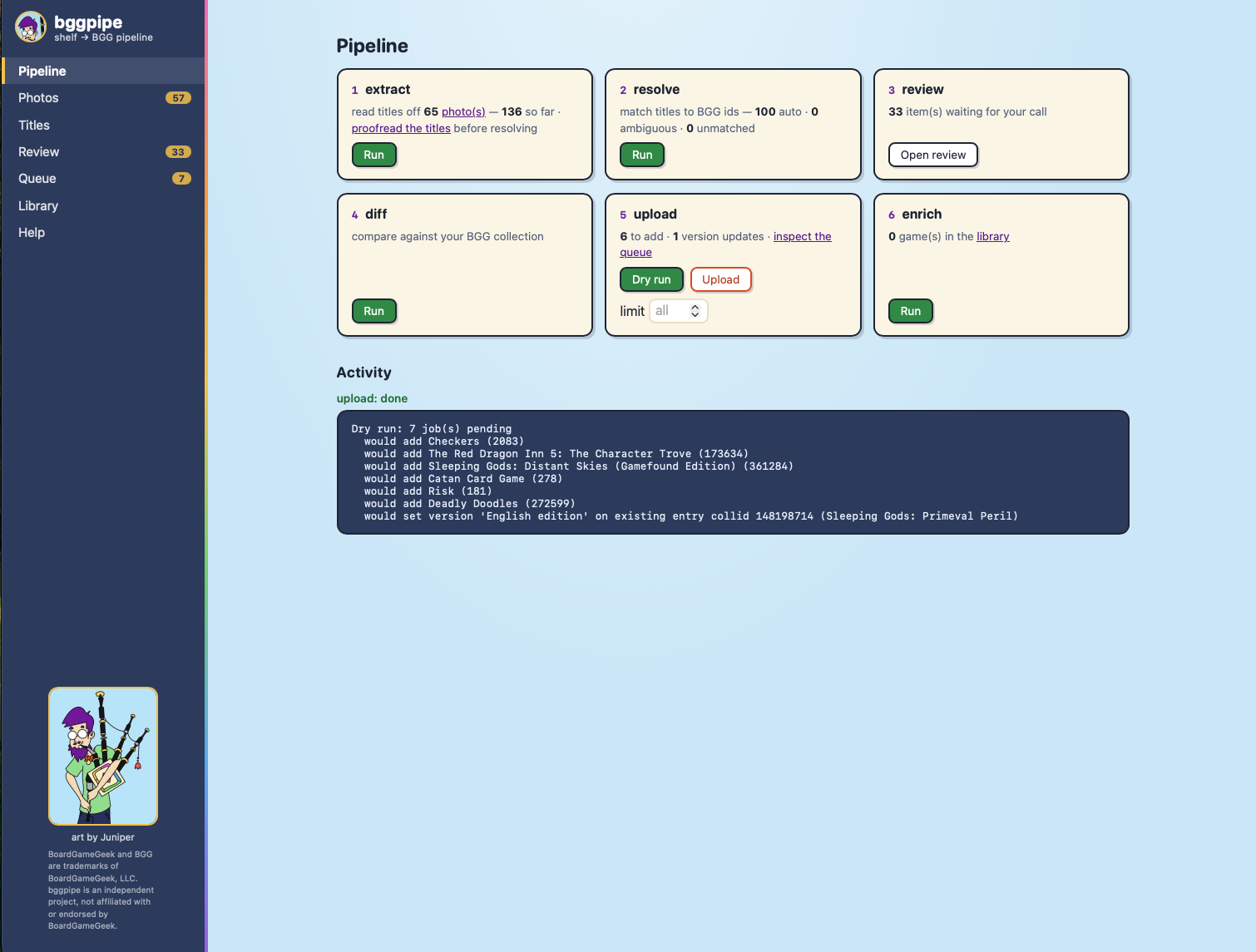
-
The browser runs headed by default — BGG's Cloudflare check blocks headless ones, and a first login may need one human click before the session is saved locally and reused.
-
Requests are slow on purpose (seconds between actions, per BGG's API policy); the Queue page shows exactly what will run before it runs, and
upload_log.csvkeeps a permanent record of every attempt. -
--retry-failedre-attempts failures;--verifyre-fetches your collection and cross-checks the log. Note that BGG's collection export can lag the website by hours — freshly-landed work may look missing todiff/--verifyuntil it catches up. -
Review decisions outrank the queue: re-deciding a match after
diffretires its queued job automatically.

Running before your BGG token arrives
BGG application approval can take a week or more. Until then: extract works immediately (it only needs the vision key), and resolve does what it can, parking the rest as "waiting on BGG API token" — it picks them up automatically once the token exists. Everything is saved as you go.
diff normally fetches your collection live, but there's a logged-in-browser exemption that needs no token: while signed in to BGG, save these two URLs as data/collection_snapshot_base.xml and data/collection_snapshot_expansions.xml (if you get a "queued" message, refresh after a few seconds):
https://boardgamegeek.com/xmlapi2/collection?username=YOU&own=1&version=1https://boardgamegeek.com/xmlapi2/collection?username=YOU&own=1&version=1&subtype=boardgameexpansion
Shelf-space planning
Physical box dimensions live on BGG versions, not games, so enrich collects
them in a second cached pass: your exact version's numbers where you chose
one, otherwise a value only when every listed printing agrees (within half an
inch per axis — disagreement is stored as conflicting, never guessed, and
BGG's 0 means "never entered", not zero inches). Then:
bggpipe dims
reports coverage, the ten biggest footprints, and a fit check against an IKEA Kallax cube (13.2" × 13.2" opening, 15.4" deep) — listing every box that fits in no orientation, and every game whose dimensions can't be verified, because can't-verify is not the same as fits. Trusted dimensions also show on each game's Library detail page.
Publishing your library on your own site
bggpipe export --out ~/my-site/static/library --title "My Game Shelves"
Writes the library as self-contained static pages: an index with search, one
page per game, and a local copy of every cover (public pages must not hotlink
BGG's image CDN). No server, no build step — drop the directory into any
static host, Hugo/Jekyll static/ folder included. Re-runs are idempotent:
already-downloaded covers are kept, failed downloads are retried, and page
URLs stay stable.
What's included follows a privacy rule: cover art, stats, your editions, and your hand-added local games — never your shelf photos (they picture the inside of your home; they stay in the private app).
BGG's API policy asks public-facing apps to display the "Powered by BGG"
badge. The footer carries a text badge automatically; to show the official
logo, save it from your registered application page at
boardgamegeek.com/applications as
data/powered-by-bgg.png and re-export.
Keeping your data safe from git
The README's quick start — installed as a tool, run in a directory of your own — is the only supported way to use bggpipe on your collection. Everything the pipeline produces lives where you run it, and uv tool upgrade bggpipe picks up fixes without going anywhere near your data.
Why not clone and run? The source repo doubles as its author's live pipeline: data/ ships with their real artifacts, committed and updated often. Run inside a clone and your data lands at git-tracked paths — the next git pull will refuse to merge, and the usual remedies (git reset --hard, git checkout ., git stash, git clean -fdx) would destroy your review decisions, hand-written games, upload log, and photos. bggpipe detects this arrangement and warns at init and on the web dashboard; don't ignore it.
One committed file of the author's data deserves a word: data/STUB_DATA.marker is normally absent. It appears only if the synthetic stub fixtures (from scripts/write_stub_fixtures.py) regenerate the CSVs, and the upload stage refuses to run while it exists — so placeholder data can never reach a real BGG account.